Before we begin, allow me to ask you a question. Of the 49 countries in sub-Saharan Africa, how many can you name?
For some, Nigeria and Ghana roll off the tongue. Maybe you even know some friends from these places. Members of the African diaspora often settle in North America, the United Kingdom, and France, searching for an improved quality of life and better prospects for themselves and their children.
Yet for many Westerners, little is known about the inner workings of the plethora of other African countries, particularly those actively working to dismantle the footprint of Western-style imperialism.
Leading the charge for Burkina Faso is 37-year-old military ruler, Captain Ibrahim Traoré. Since staging a coup in 2022 and overthrowing his mentor and predecessor, Paul-Henri Sandaogo Damiba, Traoré has pushed reforms that include increasing the pay of civil servants, reducing ministerial pay, and setting up a state-owned mining company projected to process 150 tonnes of gold annually (ISS Africa). Additionally, under Traoré, Burkina Faso has withdrawn from the Economic Community of West African States (ECOWAS) and embraced military rule through his mobilization of ordinary Burkinabe for the Volunteers for the Defense of the Homeland militia.
When his social reforms are translated into the terminology of 21st century Western-style politics, one could conclude that Traoré stands left, while his militaristic methods lean right, but a deeper truth remains.
Traoré’s mission as leader of Burkina Faso can be summed up by his own declaration to Russian president Vladimir Putin: “The terrorism we are witnessing today comes from imperialism…if we put an end to this war, if we have a strong army, we will be able to engage in developing our homeland” (kremlin.ru). In attempts to protect Burkina Faso’s physical borders from terroristic efforts of Jihadist insurgent groups, Traoré has formed a tight relationship with Russia. The “deployment of a Russian paramilitary brigade” serves as proof of the lengths he has gone to in hopes of securing his regime and its shaky position of power (BBC).
As one can imagine, an anti-imperialist stance doesn’t sit well with France, Burkina Faso’s former colonizer. French president Emmanuel Macron has expressed discontent with Traoré’s rule and accused Russia of hypocrisy where “sovereignty” and the dismantling of “colonial exploitation” are concerned (BBC).
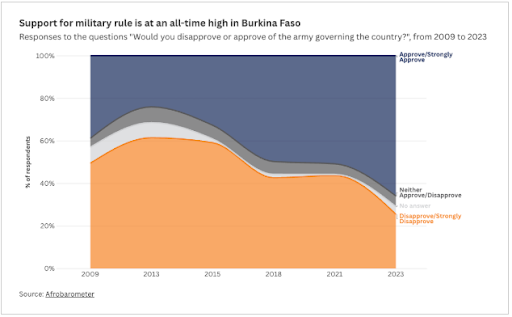
The contrast between Western imperialism and African imperialism reveals France’s hypocrisy. Burkina Faso’s population, with an average age of 17.7 years, largely supports the mission of Ibrahim Traoré. From ISS Africa on the population of Burkina Faso, or Burkinabe, “66% accept military rule, up from 24% in 2012.” Importantly, Traoré’s target audience supports his rule. It is systematically easier to implement a regime shift when the ruled class cooperates.
The new-age terrorism Traoré previously described comes in a time when social media presents an interesting challenge—how “good” is Traoré is the eyes of the public, and how can social media users’ boundless ability to craft narratives impact that perception?
Digital fame has overshadowed the real, underlying story: living conditions for Burkinabe, of which young people make up a sizable portion, must be improved. His stance of anti-colonialism is attractive to teens, who are also the main audience of social media and creations forecasting what rule under Traoré looks like. Artificial intelligence has played a role in “immortalizing him” (BBC), as fabricated Burkinabe support protests and artificial videos of singers like R Kelly, Rihanna, Justin Bieber, and Beyonce honoring his work circulate the digital sphere.
Social media has made his rise to power seem positively sensational and his rhetoric is spreading to African countries who themselves face civil unrest. This could be seen as an unrealistic perspective, though, as he’s simply leading a “fragile transitional government” that lacks “measurable improvements in security and civic freedoms… It’s algorithmic populism; emotional, visual, anti-Western and hyper-shareable…It’s about vibe and vision and not fact or policy. Social media platforms reward spectacle and Traoré’s image fits perfectly into that ecosystem”’ (The Africa Report). Without a doubt, Traoré has vast potential in the climate he’s operating in, but for right now it’s just that: potential.
As students, as youth, and as social media users, we have the power to debrief the facts behind a story and understand its tangible impact. In an age where technology’s ability to report is just as fast as global events unfold, it’s important to be the man in the middle. Educate yourself and your fellow peers and be open to the countless sides of one story; your open mind can benefit not only your understanding of the world around you, but also those experiencing hardships in the world around you.
Finally, in Ibrahim Traoré’s infamy, is he delivering the results that onlookers and Burkinabe hoped?
According to the International Monetary Fund, Burkina Faso’s economy is projected to remain stable throughout 2025, thanks to “‘commendable progress’ in raising domestic revenue, containing the public wage bill, and increasing spending on education, health and social protection” (BBC).
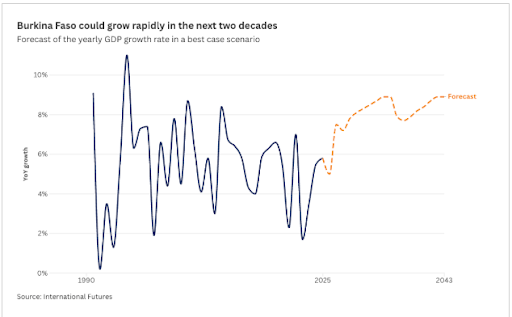
Traoré’s attempts at implementing reforms seem to be working to the benefit of his population. His approaches, while looked down upon by some, might serve as an example that a region’s culture, perhaps itself impacted by large-scale imperialism, has a deep impact on the rule they prefer.
While high schools students are not provided the opportunity to learn about every in country in depth like they are Western countries, the situation in Burkina Faso sheds light on the diversity of thought available in educating oneself.
African countries are not monolithic—no society is monolithic—and to assume so is to ignore the greatness that comes from widespread and fervent social consciousness.