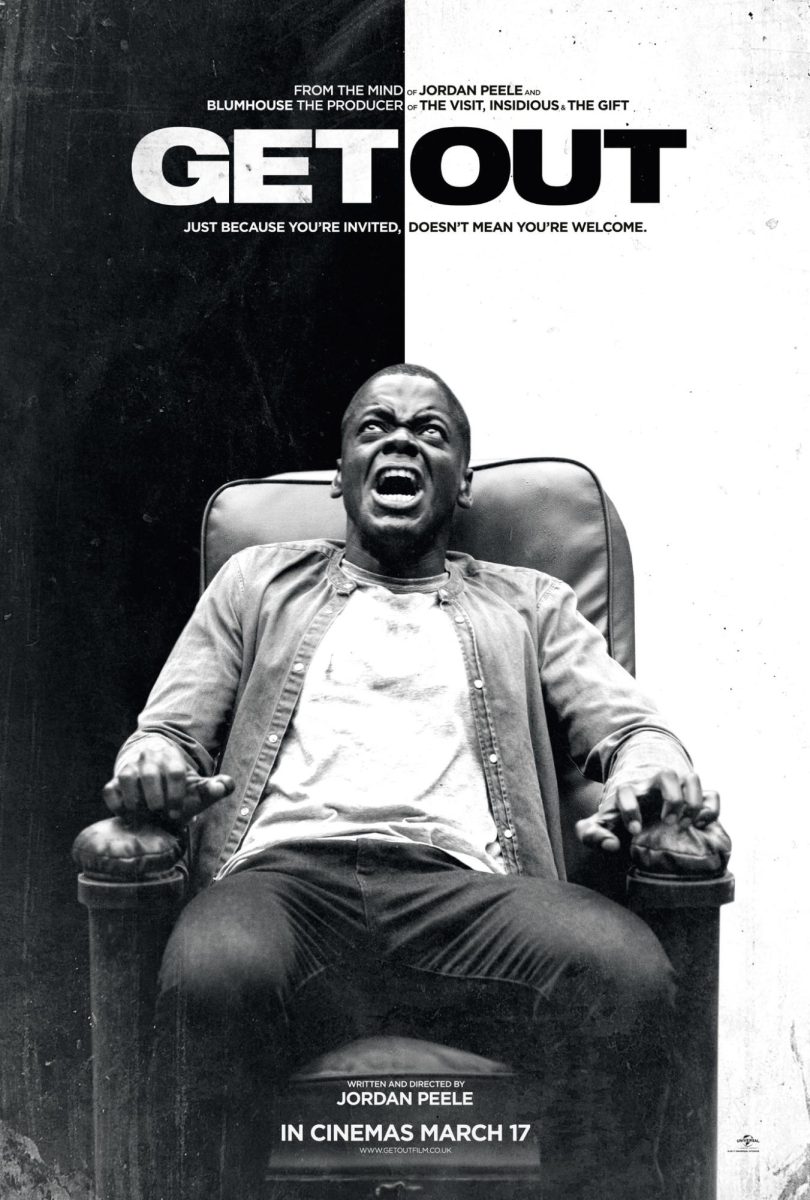
For many Black people, the world is not as simple as listening to others say, “I’m not racist.” In reality, we navigate a landscape filled with subtle judgments, coded language, and systems that still carry the weight of racism. Sociologists call these moments “microaggressions”—small comments or actions that signal deeper assumptions. Jordan Peele’s 2017 film, Get Out, follows Chris, a Black man visiting his white girlfriend’s family for the first time. What initially appears to be an awkward weekend of forced politeness slowly reveals something far more sinister, and in so doing serves as commentary on the state of American political dynamics as it relates to the Black population.
When Chris arrives at Rose’s house in Get Out, her father Dean quickly tries to prove he’s one of the “good ones,” telling Chris he would have voted for Obama for a third term if he could. He even calls it a “privilege” to experience another person’s culture. The comments are meant to sound welcoming, but they land awkwardly on Chris’s ears. Moments like these are familiar to many Black people—the uneasy mix of politeness and performance that signals when someone is trying a little too hard to prove they aren’t racist, which begs the question of what exactly it is that they trying to hide, prove or convey.
On the drive to the house, Chris and Rose hit a deer. When the incident is explained, Dean launches into a rant about how deer are a nuisance that should be eradicated. To some viewers, it’s just an odd tangent. But to a Black audience trained by society to read between the lines, it’s the first hint that something more disturbing and hateful lies beneath the family’s friendliness.

The garden party scene further reveals how racism can disguise itself as curiosity or admiration. As Chris interacts with the Armitages’ wealthy, white guests, many of them ask intrusive questions about his physical abilities, culture, and athleticism. One guest even remarks that “Black is in fashion,” reducing Black identity to a trend or commodity. While the guests appear polite, their questions treat Chris less like a person and more like a spectacle.
Moments like these reflect real-life experiences in which Black people are exoticized, stereotyped, or valued only for perceived physical or cultural traits. By exaggerating these behaviors through horror, Get Out displays how objectification can hide behind compliments and reinforces the idea that Black people aren’t “crazy” for seeing these dynamics at play or for being bothered by them.
One of the most powerful metaphors in the film is “The Sunken Place,” where Chris is trapped after being hypnotized by Rose’s mother, Missy. Missy hypnotizes Chris under the guise of being able to get rid of his smoking habit with hypnotic therapy, but the feeling of hypnosis feels more woozy than he believes it should, and rightfully so. In this state, he can see what is happening around him but has no control over his own body.
Dubbed “The Sunken Place,” this state has since become a cultural metaphor for the feeling of being silenced or powerless within systems that marginalize Black voices. In a classroom setting, this concept provides a vivid way for students to understand how systemic racism can limit agency, leaving people aware of injustice but unable to influence the structures around them.

The film’s most evidently disturbing moment comes during the silent auction, where the party guests secretly bid on Chris’s body. The scene represents the historical realities of slavery, when Black bodies were literally bought and sold as property. The Armitage property itself, described as “total privacy” with the nearest house being across the lake, has the large, main house and abundant land consistent with that of a plantation. Although the setting appears modern and sophisticated, the underlying system is hauntingly familiar.
By connecting contemporary characters to historical practices, Get Out can remind audiences that exploitation has simply changed form. The prison system is a modern-day slavery, in which Black people are imprisoned at disproportionate rates to do work for little to no pay, or for basic necessities like food and water; this is not dissimilar to slavery. Teaching scenes like this in schools would allow students to see how horror can reveal the lingering effects of America’s racial history and its modern day manifestations in ways that traditional lessons might not fully capture.
As a Black person, although young, I find myself often hardened to the harsh and unforgiving language and tendencies of people who don’t understand that I am different simply by existing. The same way sophomores read “The Picture of Dorian Gray” and learn how class and identity shaped stories of the 18th century and perform “Romeo and Juliet” to observe youth struggle in society and consequences of failed authority figures, “Get Out” and Black horror films like it are a tool for understanding the plethora of systems at play in the mere existence of Black people in America.
People love to observe us, so why shouldn’t they learn a thing or two?