

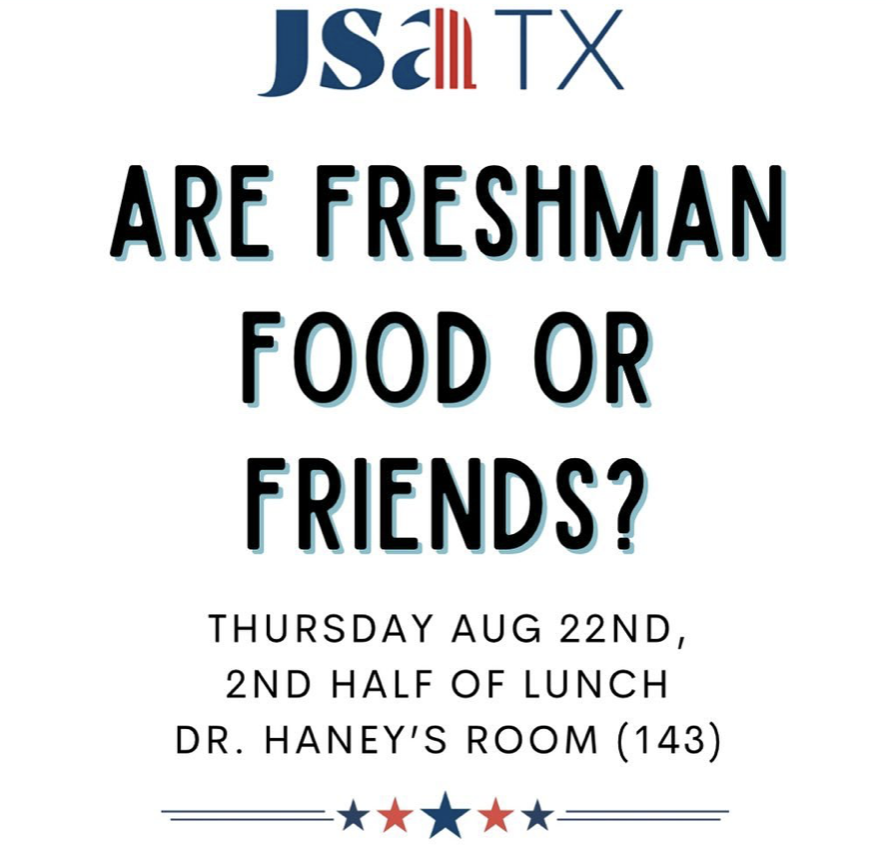
After this year’s conclusion in Dr. Geography’s room that freshmen are, quite literally, food, upperclassmen have begun preparations for what some are already calling “the most anticipated event of the year.”
Each year, the Civic Leaders of America (CLA) hosts its long-running seminar to address the question: Are freshmen friends or food? This year’s debate ended in a verdict that has reshaped daily life for many students — and, apparently, reclassified freshmen entirely.
Following the announcement, senior leadership convened daily to finalize route assignments, review procedural rules, and distribute Freshman Emergency Preparedness Packets across campus. The packets, which include recommended travel routes, handbook-style “avoidance techniques,” and annotated maps of crowded areas, have been picked up and studied with unexpected fervor by the freshman class.
“I’m just glad I managed to grab one before they ran out,” freshman Mia Jumbo says, clutching her packet like a study guide. “Page four even explains how to back away from a senior without drawing attention. It’s basically a survival curriculum at this point.”
Administrators, for their part, say they are monitoring the situation with measured concern. “We are aware of increased campus movement patterns and are advising students to stay in designated areas unless absolutely necessary,” Mr. Gather stated in a brief email distributed to staff and students Tuesday afternoon. “We remind all students that scheduled school activities should maintain standard safety protocols.”
Despite the official warnings, seniors appear undeterred. Groups can be spotted during passing periods consulting clipboards, comparing screenshot annotations of the campus layout, and quietly debating which hotspots are most likely to yield freshman “sightings.” Senior Sebastian Phish, who is currently organizing what he refers to as “Route C reconnaissance,” insists the activity is simply tradition.
“We’re just following the ruling. We check maps. We observe movement. It’s like tracking a migrating species,” Phish says without sarcasm, though several onlookers appear unconvinced.
Senior Gloria Apple agrees. “We’re not doing anything weird,” she adds. “We’re just… preparing. It’s what any responsible upperclassman would do at this time of year.”
Across campus, the effects of the announcement ripple outward. In the science wing hallway, freshmen now travel between classes in close-knit clusters, a tactic recommended in the packet’s “Safety in Numbers” section. Algebra teacher Ms. Linear remarks that her third period arrived last period “out of breath and in formation,” having apparently followed one such cluster along recommended safe zones.
“They said something about the vending machines being checkpoints,” she says, adjusting her hair. “I honestly don’t know what’s happening anymore.”
In the cafeteria, groups of freshmen can be seen huddling near the service line, debating the merits of various packet sections. “I think the hallway chart should have color coding,” freshman Daniel Prey suggests to his lunch table. “There’s only so much space near the courtyard and I don’t want to be anywhere near the seniors’ table.”
Meanwhile, a handful of juniors have attempted to insert themselves into the situation by volunteering as what they call “neutral observers,” a role that consists mostly of watching events unfold and taking occasional notes. “If seniors get clipboards, why can’t we get something?” junior Natali Aqua asks. “Walkie-talkies maybe? Binoculars?” When reassured that binoculars are unnecessary indoors, she nodded and began making a list of alternate equipment.
School administration continues to remind students of standard classroom expectations — though recent announcements have grown more specific. “We ask that all students maintain respectful behavior toward one another,” Principal Algae said over the intercom yesterday. “This includes appropriate conduct during non-athletic campus activities and avoiding unnecessary crowding in hallways.”
Seniors, however, interpret this guidance through the lens of tradition. During lunch, a group of seniors reviewed an online document they have dubbed “Hunt Protocol V.2,” which includes sections on designated observation times and what Apple terms “respectful engagement strategies.”
Freshmen, for their part, have adapted impressively. Many now refer to the packets as study guides and have developed their own terminology for senior movements — phrases like “peak hours,” “quadrant shifts,” and “safe corridors” are now common during class discussions.
“I mean,” Phish says, leaning back in his chair, “it’s honestly kind of fun. Like a school-wide game of tag.”
Whether the situation will calm down or continue to evolve remains to be seen. But for now, Carnegie’s halls buzz with a unique mixture of organizational zeal, mild anxiety, and the dead-serious tone of students convinced that a packet and a clipboard are the keys to survival.
This story is satire.


